8 min read
Best Business to Start in 2027: 8 Ideas Backed by Real Data
8 business ideas for 2027 backed by BLS and Census data, from AI services and senior care to healthy food franchises, plus how to pick one for your budget.

In this article
- The Short Answer
- 1. AI Implementation Services for Small Businesses
- 2. Cybersecurity Services for Small Businesses
- 3. Senior Care and Aging-in-Place Services
- 4. Home Energy and Solar Services
- 5. Healthy Food and Juice Bar Franchise
- 6. Skilled Home Services
- 7. Bookkeeping and Back-Office Services
- 8. Pet Services
- How to Choose the Right Business for You
- Start From Scratch or Buy a Franchise?
- Frequently Asked Questions
The Short Answer
What is the best business to start in 2027? The best business is one where real demand meets your skills and budget. Government data points to a few clear growth areas heading into 2027: helping small businesses adopt AI and stay secure, serving an aging population, home energy and skilled home services, and convenient healthy food. Americans filed about 5.6 million new business applications in 2025 (U.S. Census Bureau), so competition is real. Pick an idea with proven demand and a plan you can fund.
Planning to start in late 2026 or early 2027? The ideas below apply to both, and range from innovative tech services to proven business opportunities like franchising. Each one includes why demand is growing, the typical startup cost level and who it suits.
The 8 Ideas at a Glance
| Business idea | Why demand is growing | Startup cost | Best for |
|---|---|---|---|
| 1. AI services for small businesses | Most small firms are not using AI yet | Low | Tech-savvy problem solvers |
| 2. Cybersecurity for small businesses | Information security jobs projected to grow 28.5% | Low to medium | IT and security pros |
| 3. Senior care and aging-in-place services | All baby boomers will be 65+ by 2030 | Medium | Caring, organized people |
| 4. Home energy and solar services | Solar installer jobs projected to grow 42.1% | Medium to high | Trades and project managers |
| 5. Healthy food and juice bar franchise | Only 1 in 10 adults eats enough vegetables | Medium to high | Owners who want a proven system |
| 6. Skilled home services | Homes always need repair and upkeep | Low to medium | Hands-on operators |
| 7. Bookkeeping and back-office services | Millions of new businesses need help each year | Low | Detail-oriented professionals |
| 8. Pet services | Pet care is a steady, repeat-visit business | Low to medium | Animal lovers with local reach |
Startup cost levels are general guides. Your actual costs depend on location, scale and licensing.
1. AI Implementation Services for Small Businesses
Why now: AI use is spreading unevenly. About 17% to 20% of U.S. businesses report using AI, but use is much higher at larger firms and has barely moved among firms with fewer than 20 employees (U.S. Census Bureau, 2026). That gap is the opportunity: small businesses want the benefits but lack the time and know-how.
What you would sell: setting up AI tools for customer service, scheduling, bookkeeping or marketing, training staff, and writing clear policies for safe use.
Startup cost: low. You mainly need expertise, a laptop and software subscriptions.
2. Cybersecurity Services for Small Businesses
Why now: The Bureau of Labor Statistics projects information security analyst jobs to grow 28.5% from 2024 to 2034, the fastest of any computer occupation (BLS). Small businesses face the same threats as large companies with far fewer defenses.
What you would sell: security audits, managed backups, password and device management, phishing training and incident response plans.
Startup cost: low to medium, depending on certifications and insurance.
3. Senior Care and Aging-in-Place Services
Why now: By 2030, every baby boomer will be 65 or older, and older adults are projected to outnumber children in the U.S. by 2034 (U.S. Census Bureau). Healthcare and social assistance is projected to be the fastest-growing industry sector through 2034 (BLS).
What you would sell: non-medical home care, companion services, home safety modifications, meal delivery or care coordination for families.
Startup cost: medium. Expect licensing, insurance and staff training costs, which vary by state.
4. Home Energy and Solar Services
Why now: BLS projects solar photovoltaic installer jobs to grow 42.1% and wind turbine technician jobs 49.9% from 2024 to 2034, the two fastest-growing occupations (BLS). Both start from a small base, but the direction is clear.
What you would sell: solar installation, battery storage, energy audits, EV charger installation or insulation upgrades.
Startup cost: medium to high, with licensing, equipment and insurance requirements.
5. Healthy Food and Juice Bar Franchise
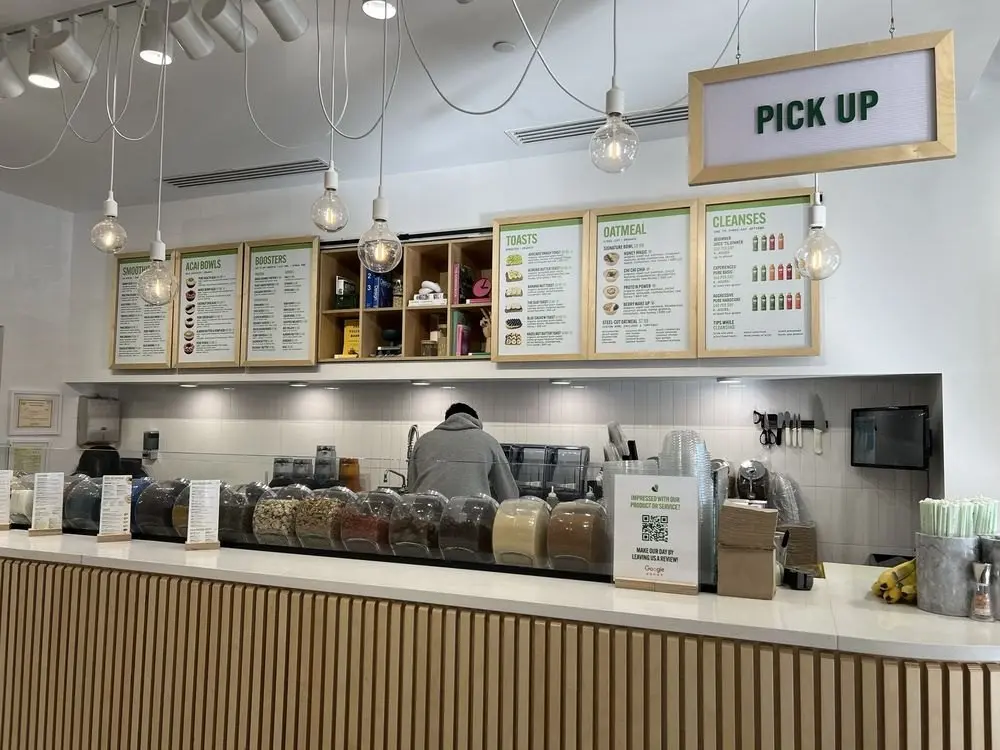
Why now: Most Americans want to eat better but struggle to do it. Only about 1 in 10 U.S. adults eats the recommended amount of vegetables (CDC, 2022), which creates steady demand for fast, convenient healthy options such as cold-pressed juice, smoothies and acai bowls.
What you would sell: a menu of healthy grab-and-go food and drinks, built around repeat daily visits.
Startup cost: medium to high. Building a food business from scratch means developing recipes, suppliers, food safety systems and a brand. A franchise provides those from day one. For example, a Pure Green juice bar franchise has a total initial investment of $177,450–$493,900, with a $40,000 franchise fee and a store footprint of 500–1,500 sq ft. See our guide to opening a juice bar.
6. Skilled Home Services
Why now: Plumbing, electrical, HVAC, handyman and cleaning work cannot be outsourced or automated away, and homeowners need it year after year.
What you would sell: repairs, maintenance plans, cleaning or specialty services such as gutter care or pressure washing.
Startup cost: low to medium. Licensed trades need certification, and every service business needs insurance and reliable transportation.
7. Bookkeeping and Back-Office Services
Why now: With about 5.6 million new business applications filed in 2025 (U.S. Census Bureau), there is a constant stream of new owners who need help with bookkeeping, payroll, sales tax and invoicing.
What you would sell: monthly bookkeeping, payroll setup, financial reporting and fractional office management.
Startup cost: low. Credentials and accounting software help you stand out.
8. Pet Services
Why now: Pet care is built on repeat visits: grooming, walking, boarding and training happen on a schedule, which makes revenue more predictable.
What you would sell: mobile grooming, dog walking, pet sitting, training or pet waste removal.
Startup cost: low to medium. Mobile grooming vans and boarding facilities cost more than walking or sitting services.
How to Choose the Right Business for You
- Start with your budget. Know your liquid savings, what you can borrow and how long you can go without a full salary.
- Match your skills. A business that uses what you already know is faster and cheaper to launch.
- Check local demand. Look at competitors, search interest and who would buy from you in your area.
- Decide your role. Do you want to work in the business every day, or manage a team?
- Plan for the long run. Building a lasting business is hard. About a third of U.S. business establishments that opened in 2013 were still operating ten years later (BLS). A solid plan, enough capital and a proven model all improve your odds.
Still unsure where to start? Read what to do if you want to start a business but have no ideas.
Start From Scratch or Buy a Franchise?
| Start from scratch | Buy a franchise | |
|---|---|---|
| Brand | You build it | Established and recognized |
| Systems and training | You create them | Provided |
| Upfront cost | Often lower | Includes a franchise fee |
| Ongoing fees | None | Royalties and marketing fees |
| Control | Full | Within brand standards |
| Support | Your own network | Franchisor and other owners |
If you are drawn to idea #5, a franchise gives you a tested menu, suppliers, training and help with site selection. Before you invest in any franchise, review its Franchise Disclosure Document and talk to current owners. Learn how Pure Green supports franchise owners.
Frequently Asked Questions
What is the most profitable business to start in 2027?
No one can promise profit for a business type. Profitability depends on your location, costs, pricing and execution. Service businesses with low startup costs, such as AI consulting, bookkeeping or cybersecurity, can reach profitability with less capital. Storefront businesses cost more upfront but can grow larger.
What is the best business to start with little money?
Service businesses built on your skills: AI implementation, bookkeeping, cybersecurity consulting, pet sitting or cleaning. They need little equipment and no storefront.
What is the best business to start for beginners?
A business that uses skills you already have, or a franchise that provides training and a proven system. Avoid businesses that require licenses or large equipment purchases until you have tested demand.
What are the trending business ideas for 2027?
Based on government data: AI services for small businesses, cybersecurity, senior care, home energy and solar, healthy food concepts, skilled home services, back-office services for new businesses, and pet care.
Is it better to start a business or buy a franchise?
It depends on how much you want to build yourself. Starting from scratch gives you full control and usually costs less upfront. A franchise costs more but provides a brand, systems and support.
Can I start one of these businesses in late 2026?
Yes. Many owners use the last months of the year to write a business plan, secure funding and register their business so they can open early in the new year.
Sources
- U.S. Census Bureau. Business Formation Statistics. https://www.census.gov/econ/bfs/index.html
- U.S. Census Bureau. Large Firms With at Least 20 Employees Biggest AI Users (Business Trends and Outlook Survey), 2026. https://www.census.gov/library/stories/2026/05/ai-use-businesses.html
- U.S. Bureau of Labor Statistics. Employment Projections, 2024–2034. https://www.bls.gov/news.release/ecopro.nr0.htm
- U.S. Census Bureau. Demographic Turning Points for the United States: Population Projections for 2020 to 2060. https://www.census.gov/library/publications/2020/demo/p25-1144.html
- Lee SH, et al. Adults Meeting Fruit and Vegetable Intake Recommendations, United States, 2019. MMWR. 2022;71(1):1–9. https://www.cdc.gov/mmwr/volumes/71/wr/mm7101a1.htm
- U.S. Bureau of Labor Statistics. 34.7 percent of business establishments born in 2013 were still operating in 2023. https://www.bls.gov/opub/ted/2024/34-7-percent-of-business-establishments-born-in-2013-were-still-operating-in-2023.htm
This article is for general information and is not financial, legal or tax advice. Franchise offers are made only by Franchise Disclosure Document.
Own a Pure Green
Learn about owning a Pure Green franchise
Tell us where you'd like to open and our franchise team will follow up with territory availability and next steps.
- Total investment $177,450–$493,900
- Liquid capital from $100,000, net worth from $300,000
- 500–1,500 sq ft footprint